
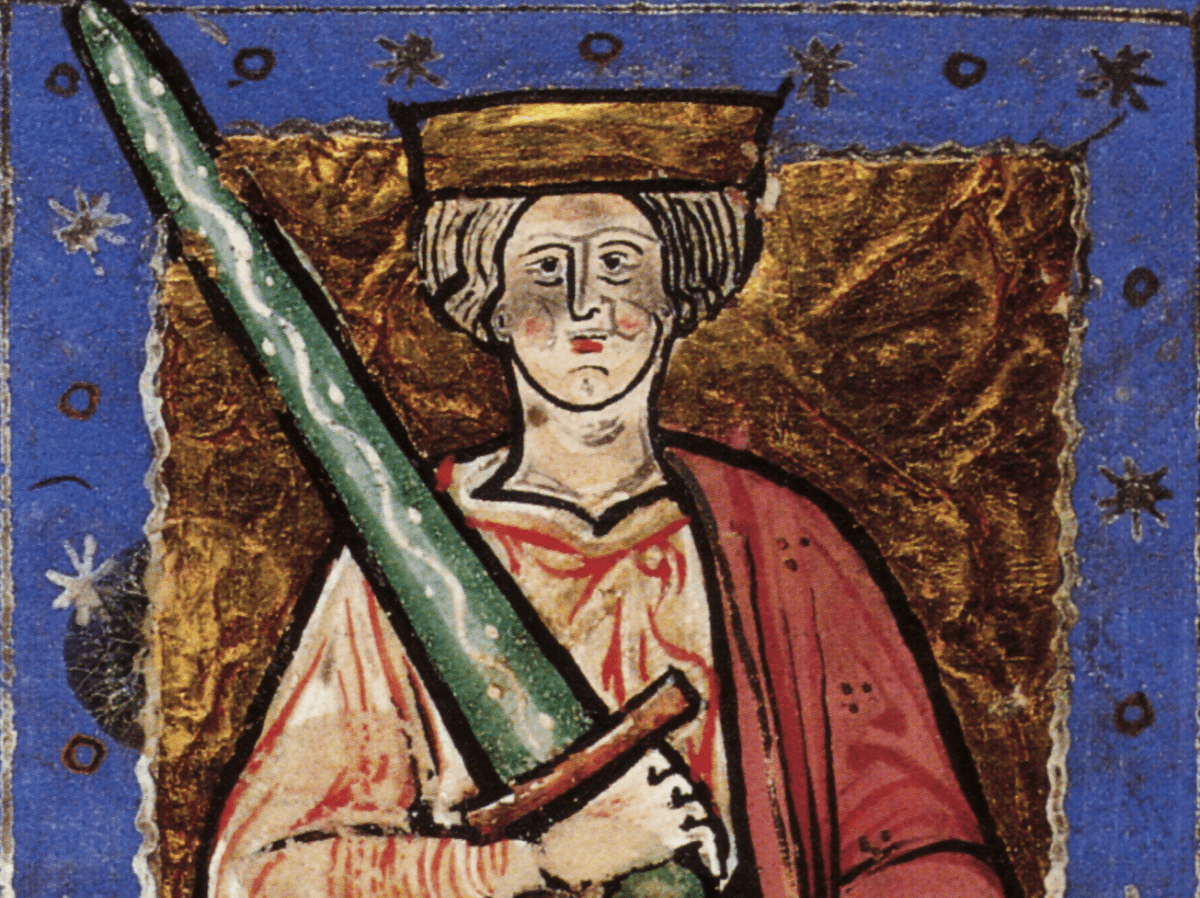
by Levi Roach
(Yale University Press, 392 pp.)
It would be fair to say that Æðelred II of England (978-1016) has enjoyed a bit of a poor press. This is only partly the fault of language change. Equally as responsible is ‘salvation history’ in which his sticky end must be explained by his actions. Levi Roach’s winner of the History Today Longman Book Prize 2107 aims to be sympathetic without whitewashing.
Birth & Childhood
The chapter on Birth & Childhood would be better named simply as ‘Context’. At times, it feels as though this is really going to be a book about Edgar. Edgar’s reign is critical not just in terms of the overall framework in which Æðelred grew up but also in the orders of the day: administrative centralisation and monastic reform (underpinned by the Regularis Concordia, the most important document of the English Benedictine Reform, sanctioned by the Council of Winchester in about 973.).
Edgar the Peacemaker’s reign was a key moment in the development of a consolidated kingdom and saw the development of new systems of administration: shires, shire reeves, tithings and hundreds. Around 973, the year of his second coronation at Bath, there was a major overhaul of the monetary system. This was also the period in which English monarchs settled for ‘King of the English’ rather than making a claim to all Britain – although they continued to exert a massive influence over their neighbours.

(British Library)
After a relatively slow start, the book now starts to get interesting.
Wives and factions
Edgar’s personal life is described by Levi as ‘serial monogamy’ and he is associated with three different women. Some of them are likely to be political marriages and it is interesting that two of the three are skewed towards the early years of his reign; when he needed the most support. Unfortunately, they are the two of which we know least.
(i) Æðelflæd
It is believed that she was his first consort and that she was daughter of Ealdorman Ordmær, probably someone of significance in the areas ruled by Edgar over the period 957-959 (essentially, the territory north of the Thames). Æðelflæd was definitely of noble stock and mothered Edgar’s first child, Edmund, who was probably born at the end of the 950s or the beginning of the 960s.
But what became of her is unclear. Of course, she could easily have died during childbirth. But there is also the possibility that Edgar chose to dissolve the marriage.
(ii) Wulfþhryð
The other early consort, raised at Wilton to which she would later retire. Although her background still remains obscure, her connections suggest that she was of elevated status. Her daughter with Edgar, Eadgyð, was to go on to become abbess.
However, it is not clear whether this ‘marriage’ was ever formalised – there was nothing unusual in that up until this point.
(iii) Ælfþryð
It would seem to be no accident that we know so much more about Ælfþryð. She was always going to be a force with which to be reckoned. Her family was amongst the most powerful in the South of England. Ordgar was an ealdorman from the South West from 964 although he may have gained this role as part of his daughter’s marriage arrangements. It was not Ælfþryð’s first marriage. She had formerly been married to Æþelwold of East Anglia, the eldest son of the Half-King.
It was also a decisive moment in the development of English queenship. Asser, the Welsh biographer at Ælfred’s court, had always been critical of the West Saxon tradition on queenship, which he described as ‘wrongful’. There was a supposed logic though in the behaviour of Beorhtric’s wife in the late eighth century, She had been tyrannical, even slaughtering (even if only by accident) her own husband. It is never mentioned but, of course, she herself was absolutely not a West Saxon, she was Offa of Mercia’s daughter (see a previous posting on Offa). She may even have been important in changing attitudes towards marriage. With the exception of Cnut, subsequent kings were more restrained.
We first see her as recipient of an estate at Aston Upthorpe – in Berkshire at the time but now in Oxfordshire (just outside Didcot). There are signs here that monastic reformers may have played a role in her rise. A key player may have been Edgar’s former tutor, Æþelwold of Winchester. Abingdon charters do indicate that she was materially different to previous consorts and she is the only consort to get a mention in the Northern Recension version of the ASC, compiled under Wulfstan of York.
Her position would have been bolstered by producing two sons over 966 to 969: Edmund and Æðelred. Nevertheless, there is still a name hierarchy here: Edward, Edmund, Æðelred – it’s the last that needs a bit of interpretation.
Ælfþryð’s use of regina would have attempted to emphasise her two sons’ legitimacy. Æðelred himself was almost certainly too young to understand what was going on. But somewhere between him being 2 and being 6 this may have changed with the passing of his elder brother in 971 or 972. Nevertheless, Edward continued to be given precedence in charters.
Ælfþryð was later recorded as possessing a substantial estate at Æðingadean (The Valley of Princes), quite possibly the Dean Estate in Sussex, near the border with Hampshire. Æðelred may have been fostered out to a leading noble.
The failed candidacy of 975
Edgar had acceded to the throne young and one might have expected a long reign. But in 975, aged only 32, he suddenly and unexpectedly died.
Despite his age, there was a faction supporting Æðelred’s candidacy in 975. Some of this factionalism may have been a hangover from Eadwig’s reign. Jayakumar has pointed out that Edward had the support of the ‘old guard’ whilst Æðelred was backed by many of those who had risen to prominence under Eadwig. However, it is important not to over-emphasise the rivalries: many of the supporters of both sides got on well enough with one another.
The ASC for 975 records the death of Edgar, the succession of Edward and a comet. There is no mention of a succession dispute per se.
It may simply have been too fresh in the mind. Byrhtferð of Ramsey was writing just long enough later to be more honest.
Supporters of Æðelred, who was probably around eight at the time (Roach uses bands most of the time) seem to have included Æðelwold of Winchester and Ealdorman Ælfhere’s family. Supporters of Edward probably included Dunstan, whose politics often failed to overlap with Æðelwold’s, and a strong West Country base including Bishop Sideman of Crediton and Archbishop Oswald.
Although Æðelred’s supporting lobby was subsequently reconciled to the regime and appeared in charters as would be expected, perhaps the seeds of doubt had already been sown about the new 15 year old king?
An ‘anti-monastic’ reaction?
In Mercia, monks were driven out and replaced by clerics – or at least that is the traditional view, which has subsequently been modified. Ælfhere of Mercia had made all sorts of gifts to monasteries, so the idea that he could have been involved with anti-monastic actions is ridiculous. Roach argues that it is more the case of division amongst reformers – reflecting his early point that it was never ‘monastic reform’ but rather ‘monastic reforms’.
Edward, King & Martyr (975-978)
In short, not much is actually known about Edward’s reign. One can interpret that as a measure of success in troubled times, but perhaps it is truer to say that the young king never had the opportunity to find his feet.
The West Country (and especially Devon) seems to have formed the basis of Edward’s support. New appointments were often made to shore-up fledgling regimes. A Devon charter relating to Ælfsige is witnessed by two new noblemen: Æðelweard and Leofwine – and we might speculate that their appointments were designed to curtail Ælfhere’s authority? The former was to go on to play a major role in Æðelred’s administration whilst the latter remains a shadowy figure. The next diplomas we see were issued at Pydelan (unidentified but possibly Puddletown in Dorset), for Wylye in Wiltshire and for estates in Cornwall. [The Cornish example raises all sorts of issues about English expansion beyond the Tamar but that is another story…]
Whilst it may not have been that unusual (queen and æðeling attestations were periodic), it is worth mentioning that none of these documents have either Æðelred or Ælfþryð as witnesses. Perhaps there is some indication of underlying tensions and it might be no surprise, given the scheming, if the latter had been considered persona non grata. We do know that Æðelwold brought both to Ely during this period to settle local property disputes and Ælfric Cild appears also to have been a member of this clique.
Edward’s end in Dorset
If little mention is made of Edward’s life, that is not the case with regard to his death in 978 – or, to be more accurate, his murder. A Latin poem written at Canterbury around 1000 tells us that his body was taken from its resting place and taken to Shaftesbury by Ælfhere. But we have to piece together the story bit by bit.

Byrhtferð of Ramsey provides more detail (although we are actually getting the detail via a later third party). The King visited Corfe in Dorset with the intention of meeting his half brother but on arrival he was met by thanes who killed him. He was buried without any royal dignity at Wareham before Ælfhere had him moved to Shaftesbury. In theory, there is no evidence to suggest that Æðelred, his mother, Ælfhere or any of Æðelred’s supporters was directly involved. However, their response must have been a mixed one: the murder of a King was a sin marked out above all others. Wulfstan alludes to this incident in in his Sermo Lupi, written no later than 1016 and, as we shall see later, quite possibly several years earlier.
Æðelred as boy-king
It was well over a year after Edward’s death that Æðelred was inaugurated in May 979 at Kingston-upon-Thames. The site was representative of the body politic of England, being right at the frontier of Wessex and Mercia. It may be that Æðelred swore his oaths in Old English as it is not clear that he was capable of doing so in the more usual Latin. What happened in the more than 13 month gap beforehand is largely unknown but we can certainly speculate.
The translation of Edward’s body was to be one of the first acts of the new king. That may have presented issues of its own as Wulfstan indicates that the body had been burned. In 1931 a group of bones was exhumed at Shaftesbury Abbey. They may well have once been revered as the body of Edward the Martyr. They carbon date to the right period but belonged to someone in their late 20s or 30s. Edward would still have been a teenager at death. If there had genuinely been no body to be found, then the new administration might have had to find a substitute. Promoting regicide was hardly in anyone’s interest!
Something else must also have occupied time in 978 / 979. Æðelred was no more than 12 at the time and possibly younger. There was no question of him ruling on his own. There was no agreed minimum age for a king to act on his own – but it was not 12. The danger was that unscrupulous magnates would attempt to do the job in his name.
However, these roles seem to have fallen to Æðelred’s closest allies in his youth: his mother Ælfþryð, Æðelwold and Ælfhere. But, whilst supporters did get key roles, it does seem that every effort was made to be inclusive and to heal old wounds.
Regency rule was invariably a balancing act. Traditionally, queens had been popular on this front because they tended not to rock the boat and provided some continuity with previous regimes. But this clearly was not going to work in the case of Æðelred’s mother; she had been too involved in promoting her son’s accession.
That does not mean for one moment that she was not involved in the processes designed to negotiate with and to appease opponents. Indeed, the fact that the succession passed without major controversy suggests that she was very successful on this front.
The first two surviving diplomas from his reign are in favour of two of Ælfþryð’s most prominent supporters: Ælfhere and Æðelwold. The first of these was as Olney, Buckinghamshire – now in Milton Keynes UA.
The second was more of a sign of things to come as a Hampshire estate was passed to Æðelwold and Winchester’s Old Minster. A number of further charters also favoured Æðelwold.
Whilst there was no formal regent, three very equal partners played their roles and even the translation of Edward’s body fits with this scenario. In these years, Tavistock appears to have been founded by the Queen Mother’s brother, Ordwulf in around 981. Meanwhile his sister (re)founded female monastic houses in Wiltshire: Wherwell and Amesbury.
The lack of royal decrees tends to yield us an impression of tumult in the period as law-making tended to take place in the stable periods. But then again, if Stenton argued that the silence of Edgar’s reign demonstrated stability … then why not now?
The end of regency rule
However, several events of the mid 980s meant that this was all about to change.
Ælfhere died in 983 and then Æðelwold Bishop of Winchester in the following year. In 985, Ælfhere’s successor and kinsman, Ælfric Cild, was exiled from the land. It was to be the end of this family dominance over Mercia (and, at least at certain points in time, Central Wessex). But even Æðelred himself recalled the death of Ælfhere as a personal turning point.
Although it could be complete co-incidence, over the period from August 984 to Pentecost 993, Æðelred’s mother disappears from the record entirely. It seems clear that the minority regime was essentially eclipsed at this point. By the standards of the time, Æðelred was no longer a child – he now wanted things his way!
An independent time
Although he cannot have known it, Æðelred’s reign was going to be dogged by pressure from Scandinavia. Was that an unfortunate coincidence? Or did they spot the boy-king stepping away from reliable advice? Did he go from being Æðelred to being Unræd at this point?
Around 985 he seems to have effected his own marriage to Ælgifu, the daughter of ÆÞelberht. However, there is no known Ealdorman of this name at the time. It might simply be wrong or it could be mere propaganda? William of Malmesbury claims that she was of low birth but there is no supporting evidence for this.
However, we do have to consider potential comparisons with Æþelred’s future wife, Emma of Normandy. Ælfred of Rievaulx does not name her but does claim that she was daughter of Thored and there was an Earl of York who went by that name. Potentially, that might have strengthened Æþelred’s hand in the weakest point of English unity. At this point in time, we cannot tell whether this marriage was a youthful choice or politically driven by someone else. Whatever this period of independence actually involved, it is clear that his mother’s role was vastly reduced.
Now a father with his dynasty assured he began to perform the key functions of a monarch: defence of the realm, protection of both the Church and the weak and the promotion of justice in the realm. The Court was a microcosm of polity but could not be everywhere at once, hence the important roles of ealdormen and reeves. Most importantly, they provided a network to relay messages back and forth and also a visible face to royal authority.
Most charters and some diplomas do not state the place of production. But it is clear that the core of activity was in Central Wessex with a gradual shift over time to both the north and the east as both London and the Thames Valley gained increasing importance.
Ælfþryþ’s disappearance from the court record in this period was only going to be temporary, but religious houses lost land and, most especially, Abingdon. Indeed, there were direct assaults on the reformist agenda. But it seems that the hardest hit was almost certainly Rochester to which Æþelred laid waste in 986. The King and Ælfstan certainly seem to have been at loggerheads. And Bromley was not the only loss. There are echoes in the Kentish numismatic record too. Sideman of Rochester seems to have lost his supply lines in this period. In Rochester there was open violence and the period is characterised as a return to the ‘anti-monastic reaction’. Nevertheless, it was not straightforwardly anti-clerical.
Some of the men Æþelred was later to blame for his misdemeanors were named in charters over this phase. They include: Wulfgar, the Bishop of Ramsbury between 981 and 986, Eadwine and Ælfric of Hampshire. However, alongside the new guys were some more established ‘old school’ characters: ÆÞelwine of East Anglia, son of the half-King and Bryrhtnoþ of Essex. They owed their promotions to Edgar’s patronage and were known supporters of monastic reform. So, the idea that this is an anti-monastic movement is again a misguided one. Indeed, churchmen were also complicit in Æþelred’s actions.
Nevertheless, this was an abrupt shift even attacking the resting place of Æþelred’s father, Edgar – Glastonbury. Dustan and Oswald must have been looking with utter dismay. It is even possible that Ælfric Cild’s exile reflected his discomfort with the new phase of political direction.
The wages of sin and the Scandinavian arrivals
It would be wrong to suggest that the Scandinavian attacks were to the first thing to start playing on Æþelred’s mind as delivered by his immoral actions. More likely the murrain outbreak amongst cattle in 986 was. The visitors from 980 to 982 might have seemed like minor affairs. But, after a lull, the visits resumed from 988.
We have a number of sources for the next period. The most celebrated is also the most unreliable historically. To encapsulate it seems that in 991 to 993 ships landed near Folkestone, moved on to Sandwich, then laid waste to Ipswich before landing on Northey linked to Maldon by a narrow causeway for the setting of the famous poem. There the second most senior ealdorman would be cut down – a major loss.
The King, driven by the advice of Archbishop Sigeric of Canterbury decided to buy off the Scandinavians with 10,000 pounds of silver. But the whole picture is complicated by confused dates in different versions of the ASC and a splinter group of Vikings sacking Bamburgh and Lindsey in 993. In 994 Olaf and Sweyn raided Essex, Kent, Sussex and Hampshire. A new tribute of 16,000 pounds of silver was paid.

The restoration period
Æþelmær and Ordulf were critical influences during this restoration period. The first of these was a relation of Ælfhere of Mercia and recorded as discðegn. Meanwhile Ordulf was the King’s maternal uncle and was prominent in diploma witness lists.
Although they are harder to trace in documentary terms, two other characters also seem to have been important in the period: Leofsige, the Earl of Essex and Leofwine, responsible for the Hwiccan territories.
Although never regaining her former importance during the regency period, Ælfþryð appears to have returned to the scene in 993. She features prominently in an important exchange of estates which paved the way for Cholsey Abbey.

Photographed by Dudley Miles from Kingship, Legislation and Power in Anglo-Saxon England (2013), Public domain
Her return coincided with some evidence of sidelining of the King’s first wife – although the fact that she continued to bear children might indicate a continued tolerance. Indeed, she called them Edgar and Eadwig.
Despite the Viking raids of the 990s, there was substantial literary and intellectual activity: Ælfric of Eynsford, Wulfstan, Wulfstan of Winchester, Byrhtferð as well as the replication of existing texts.
A number of religious centres were either founded from scratch or re-founded: Cerne (around 987), Cholsey (before 997), Sherborne (998), Burton (1003) and Eynsham (1005).
The cult of Edward
The King never just put his former poor behaviour at his own feet; it was also the fault of misguided advisors. In this context, the 978 murder cast a shadow over the whole nation and it is against this background that the rise of the Edward cult suddenly arose. Byrhtferð records miracles starting to take place around his grave from around 990. The Viking attacks cast Edward’s murder in a new light. The foundation of Cholsey Abbey marked the first religious foundation to be dedicated to a Royal martyr. However, its history is obscure thanks to its short life.
Sigerac is likely to have had a hand in the foundation and there is every reason to presume that the King’s mother had a role in the cult’s promotion from the start.
Overseen by Wulfsige of Sherborne, in June 1001 Edward’s remains were translated again. This, of course, raises yet more issues if there was no body!
It was an important m,oment as 1001 saw a series of attacks on the South West. A cenobium at Bradford on Avon was designed in case of the need for retreat. It was left unfinished , perhaps after 1016 when the political climate had changed.

Political solutions to the Viking attacks
There were also many strictly political and military measures undertaken in response to the attacks – although politics and religious reform were very interlinked.
The 990s saw a major experiment in terms of defence. In 994 a treaty effectively enlisted a portion of the raiding force for English military service – as well as measures against Normandy and payment of 22,000 pounds of silver. Olaf was subsequently sponsored for baptism by the King. It may well have been a policy with the strategic aim of dividing Scandinavia and the King seems to have been well-informed on such issues. It is even possible he had specific information via York – perhaps even from Earl Thored.
Initially, the policy seemed to work but in 997 matters took a turn for the worse – focused on the South West. The foundation at Tavistock was attacked. In 998 there were further attacks on Dorset and the Isle of Wight. In 999 they moved round the coast to Medway before departing, seemingly of their own volition in 1000.
But in 1001 Pallig’s forces attacked Sussex where they defeated forces from Hampshire. In Devon Pinhoe was sacked. [Only later is it explained that Pallig [Tokeson] is one of the King’s Scandinavian mercenaries. And Bartlett mentions Kingsteignton’s burning here.]
From 999 most versions of the ASC sink into despair but the ‘A’ version presents an alternative voice. In 997 it is clear that the Vikings arrived at Lydford (Hlydanford) but it seems that they might have had to retreat and it is also evident from ‘A’ that in 999 English resolve was as yet not broken.
Æðelred also seems to have been more reserved about handing over tribute than is commonly assumed. There was nothing especially unusual about this in the first place. In 1001 it does seem that he was successful in the defence of Exeter. In fact, far from doing nothing, he did lots – even ravaging the Irish Sea zone from which some of the attacks were either coming or at least gaining support. [Bartlett, in his book on Cnut, suggests that this was essentially Cumbria and Man.] His real problem was that he rarely took the initiative.
He did face an additional problem over Ælfred over a century earlier: his kingdom was more than three times the size. His ability to restore Church lands speaks of him at the height of his power.
Apocalypse 1000
It is not mentioned at this point – only later – but a significant body of people thought that the World was going to end 1000 years from Christ’s birth. And the signs started to look very bad indeed.
From 1001 Æðelred’s reign starts to descend into desperation and increasing paranoia. Two dramatic events stand out over this decade: the St Brice’s Day massacre and the palace revolution of 1005/1006. Furthermore, in 1000, Normandy rekindled hostilities. It is unclear whether we can trust William of Jumiege’s claim that England attacked Contentin in 1002.
In the same year Æðelred married Emma of Normandy. Brilliantly, her name is Anglicised to Ælfgifu – the same as the Thored’s daughter, whose disappearance at this point is unexplained. Did Ælfþryð’s death pave the way for this marriage? Perhaps – but perhaps not! Very probably it was just a politically expedient match between England and Normandy. Nevertheless, it would have created shifts in the Court environment as new people were brought in. Furthermore, no English monarch had married a foreign bride since the mid-ninth century.
We now come on to the most awkward development of all…
St Brice’s Day
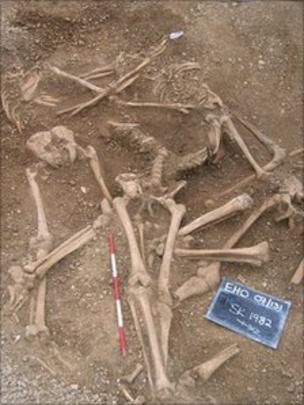
It is always awkward when the suggestion is that an attempted genocide has been exaggerated. But the order to execute all ‘Danes’ cannot have been carried out in the Danelaw. Toti, a Scandinavian appears to have gained favour at Beckley and Hornton on Otmoor (just a few miles outside Oxford). Did the King’s administration even possess a network for coercion into massacre?
Two places do turn up as witnessing a massacre: Ridgeway Hill in Dorset (not far from Corfe) and Oxford (outside Danelaw but always uncomfortably close to it). At Ridgeway male and young skeletons have turned up with serious head trauma, discarded on unconsecrated ground. It may be less than prudent to link the burning of St Frideswide’s Church in Oxford with the 34 bodies discovered near St John’s College in 2008, heaped in a ditch – they could be earlier.
The ‘Palace Revolution’ (1005/1006)
The St Brice’s Day massacre did the exact opposite of problem alleviation. In 1003/1004 Sweyn returned. William of Malmesbury’s story about Gunhild, Sweyn’s sister, having died in the attacks has to be taken with a pinch of salt. It is heavily reliant on William de Jumieges and prior to the 1050s we have no record of her existence. But Sweyn could genuinely have been acquainted with victims.
Whatever Sweyn’s reasons – and they were probably more connected with relations between Denmark and Norway – he stormed Exeter before heading inland. The Wiltshire and Hampshire forces appear to have been undermined by Ealdorman Ælfric, allowing Sweyn to take and burn Wilton before pushing on to Salisbury.
In the following year Sweyn’s focus was East Anglia. He torched Norwich, sacked Thetford and then engaged in a difficult battle with Ulfcytel. Although Sweyn then returned to Denmark, famine then hit the country and people were reduced to eating ‘unclean animals’ and even, so it was said, cannibalism.
The palace revolution was a wide-ranging changing of the guard. Æðelmaer retired, Ælfhelm was executed and his sons blinded and Wulfgeat had his lands confiscated.
It is hard to know how much he was behind the changes but there was a clear beneficiary: Eadric Streona. His rise was meteoric although little is actually known about him. He seems to have come from the NW Midlands – perhaps Shrewsbury.
At first, his marriage to Eadgið (Edith) seems to break all the rules. But Uhtred of Northumbria also seems to have had a Royal bride at this point. Wulfric Spot’s death may have started or accelerated Eadric’s rise to power. So might strategic positioning with Queen Emma. But perhaps more important than any of these factors was a personal affinity with Æðelred?
Some characters did make it through the coup though. Ælfric and Leofwine remained and Wulstan of York seems to have grown in the King’s confidence. Æðelmær may have jumped ship before trouble set in but almost everyone who disappeared was one of his associates. This might reflect in Ælfric the homilist’s darkening mood, given his base at Eynsham.
The 1006 to 1009 Period
This period is usually seen as one of mounting crisis with Æðelred attempting to implement the Eynsham programme but also facing external opposition.
There was no let up in Viking visitors. They seized Sandwich and the entire ‘West Saxon and Mercian’ nation was called up. This suggests that co-ordination of the country still rested in Æðelred’s hands. But the strain on resources was real. Reports tell of the countryside suffering because of the notional defence as well as the attackers.
As winter approached the English army disbanded. The Vikings retired to the Isle of Wight but opted for their winter raiding strategy. They made a foray to Reading, then Wallingford and Cholsey (we have no idea what happened to the foundation there).
From there they headed west to a barrow on the Lambourn Downs known as Cuckhamsley Barrow (East Hendred). To the West Saxons it had associations with King Cwichelm and huge symbolic significance. If raiders got there, then, according to legend, they would never make it back to the sea.
But they did, putting the English army to flight along the River Kennet and then marching right past Winchester. This does seem to have sent shockwaves through English society: there were no Royal charters issued in that year. But the King? He seems to have spent Christmas in Shropshire!
In 1007 Eadric was appointed Ealdorman of Mercia. Æðelred was clearly still in a position to co-ordinate ship-building and changes of issued armour. However, the mere fact of having to do such things speaks volumes about the Viking threat. Furthermore, there seems to have been a strategy for Royal landholding sell-offs. We see this at St Albans, at Ely and at Waltham St Lawrence in Berkshire. This could only ever have worked short-term and were not simply confined to the King himself: Sigeric seems to have been doing similar. The transactions were evidently made with a view to filling the Royal coffers.
There is a suspicious symmetry in the payments made as recorded in the ASC but they do seem to be broadly realistic. These payments are described as gafol and not geld suggesting that they are informal and ad hoc. But Wulfstan of York bemoans the bespoiling of churches during this period.
Enham, Hampshire – Pentecost 1008
Wulfstan had been promoted to York sometime around 1002. The Enham ordinances were entrusted to him and it is at this point that this key player steps out into the light from the shadows. The Archbishop remained firmly convinced of the proximity of the end of times – at least at this point.
Most of his texts were written as forgeries but it is unclear if anybody was expected to take them literally. The Enham exhortations combine military and administrative undertakings with moral reform and are decidedly ecclesiastic in outlook suggesting that Wulfstan’s role was almost absolute. But the separation of the political and the religious is a very subtle matter in the ordering of a strictly Christian society.
We might raise some issues here about why exhortation to worship of ‘the one God’ was necessary at this point. However, reform had now shifted beyond the monarchy to the entire nation being called into moral action. A number of fortified sites came into use as minting centres around this time. And far from being a period of terminal decline at fortified sites, this was a period of re-fortification although some of these sites might go back to the 990s: Oldaport (South Devon), the Ælfredian burghal centres, Silbury Hill, St Mary-in-Castro, Carisbrooke on the Isle on Wight. Continental-style fortified bridges were also introduced at both London and Bristol.
Crime and litigation
A high number of litigation cases in this period has traditionally been interpreted as evidence of a national crime wave. As now – and indeed for every period in between – perception is as important as incidence. It appears that what is new is not the number of cases but the detail in which they were recorded. The most infamous case regards the Crimes of Wulfbald – but the King even succeeded in bringing him to justice via a Royal assembly.
Indeed, numerous signs suggest that Æðelred’s control over justice was far from as weak as previously supposed and some additional crime may well have been directly related to the new strains associated with defending the realm.
A wider range of regulations were brought to bear more effectively with increasing centralisation, straying into new areas such adultery. But, whilst England was ruled more intensively than comparable duchies on the Continent, the differences should not be exaggerated and nothing imposed in England was was without a comparator elsewhere.
Apocalypse & atonement
Whilst sinfulness was one tradition driving the nature of times, the other was the End of Time itself. The proximity of the End Times was a theme emphasised by Wulfstan. Indeed, the apocalypse was to become a favourite theme for him – if not permanently. He drew heavily on Adso – as did others, sometimes anonymously.
Ælfric the homilist had studied at Æðelwold’s famous school in Winchester and in the late 980s he had joined the fledgling foundation at Cerne. In his First Catholic Homilies, he speaks of “This time, which is the ending of the World” (On þissum timan þe is geendung þyssere worulde). He comes back to the same theme at the end of the work. The homilist became less focused on the topic as the raids began to mount – but he seems to have been alone in this respect.
The end of the World is preceded by mounting dangerous times – tempora periculosa – which is noted across several diplomas but most explicitly in the Eynsham charter of 1005. This suggests that the King was not only concerned with the nation’s material wellbeing but also the ultimate fate of humankind as a whole.
Ælfric is famoudly cautious about being too precise about timings; it is simply approaching: is ende-next. Wulfstan was more open to speculation. Some, despite Augustine’s strictures, were literally counting down the end of time. However, evidence does not suggest that such people were that widespread. And, for most, apocalypse and the Millennium were not equivalents. That does not mean that murrain and Viking raids were not given cosmic significance.
Wulstan’s career continued to progress as the Millennium receded from sight. As it did so he shifted to understanding the times as passing punishments for sin. But the two beliefs were never entirely mutually exclusive – neglecting piety could lead to cosmic disaster, brought by the people upon themselves. Indeed, the very presence of sin is potential evidence of the End Times’ proximity.
England lost & won (1009 – 1016)
Up until 1009, it would be wrong to suggest an absolute crisis despite mounting desperation. Then Þorkell the Tall’s raiding army arrived – ‘the Great Raiding Army’. From this point to the King’s death in 1016, there is essentially a scenario of unremitting crisis and the seeds of the 1016 conquest are sown. There would be Þorkell’s impact, then Sweyn’s, then Cnut’s. Absolute failure on behalf of the English state – but never inevitable failure.
Nevertheless, much of 1008 was spent readying for the inevitable. The greatest force in living memory arrived at Sandwich. Kent was still connected to the capital via the Wantsum Channel. The last thing England needed at this point was an internal dispute – but it got one: between Eadric Streona’s brother, Brihtric, and Wulfnoð Cild, the South Saxon.
It is at this point we hear that the toil of the entire nation most critical of the ASC versions. It is not something that can simply be put to one side either: Wulfnoþ’s son, Godwine, was to be Harold’s (a.k.a. Battle of Hastings) father.
Æþelstan’s plans for defence were left in tatters, leaving the Kentish coast open to attack. Þorkell was here in 1012 and Olaf Haraldsson may also have been part of this army. One of the biggest problems with negotiating with the Viking army was its amorphous nature, making it difficult to strike deals. Realistically, Þorkell probably had somewhere between 5,000 and 8,000 men although only a fraction of this would have been his own force. From Canterbury they then struck Sussex, Hampshire and Berkshire. In response, Æþelred raised a full national levy. It is clear that Æþelred was leading from the front, even if it was only a case of containment.
The Viking army returned to Kent, proceeding via London to new points of attention in the Thames Valley and East Anglia. Taking Ipswich, they headed further north to Ringmere Heath, a strategic site and probable local mustering point outside Thetford where a battle with Ulfcytel took place. This time, however, it was the English who lost and only the men of Cambridgeshire continued fighting on.
Amongst the fallen was a relative of the King, Æþelstan – who could be either his son-in-law or brother-in-law. Þorkell put Thetford and Cambridge to the torch and then turned south into Oxfordshire, Buckinghamshire, Bedfordshire – burning all the way. The basic bonds of society were beginning to break and Þorkell got away with doing whatever he wanted.
By 1011 the situation was as follows. North of the Thames the following had been overrun: East Anglia, Essex, Middlesex, Oxfordshire, Cambridgeshire, Hertfordshire, Buckinghamshire and Bedfordshire as well as part of Huntingdonshire and some of Northamptonshire. To the south of the River: Kent, Sussex, the ‘Hastingas’ (a wider area than Hastings itself), Surrey, Berkshire, Hampshire and much of Wiltshire.
The ASC’s complaint is not payment per se as people often suppose but rather the timings. This was complicated by the fact that there were often sporadic attacks by sub-groups after truces.
September 1011 saw the Siege of Canterbury. It is not clear if the driver was spurring promised tribute into action. The Scandinavians took the city thanks to Ælfmær’s treachery. The Vikings sacked the city and took hostages. For the English, it was another shockwave. The spiritual heart of the realm, it was not just the city that had fallen, the nation’s metropolitan had fallen into enemy hands too.
But there was a worse shock to come in April 1012, the killing of Archbishop Ælfheah (Alfege) at Greenwich. Although the Vikings were nominally still known as the heathens, there were Christians amongst their ranks and they had broken the established rules of Christian warfare. There is almost no doubt that Ælfheah’s death was later embellished. The interment of England’s newest martyr brought a peace deal and it seems to be that at this point regular taxation was put in place to pay the mercenaries – a geld not a gafol.
Calamity and response
However, we have to look beyond the bare bones of the Chronicle narrative and turn our attention to strictly contemporary evidence. An exceptional source here is the VII Æþelred Ordinances of 1009 in which the King seems to have been channelling his father’s influence at Bath. Drafted by Wulfstan, it was a concerted effort to confront the nation’s ills. Although it worked within an established Continental framework, its precise form was new to the English. In effect, it was a last ditch attempt to assuage God’s wrath and possibly coincided with the issuance of the Agnus Dei coin which also broke with convention. But large parts of the country did not witness the minting of this coin, those that did being clustered around Malmesbury, Salisbury and the Midlands.
Another survival from the period is Wulfstan’s Sermo Lupi (Wolf as in Wulf!). This was previously dated as 1014 but one version is clearly dated to 1009 and the case is made that it is not a textual error. Wulfstan continually revised and re-edited his work anyway. Wulfstan’s voice may have been the loudest but it was not alone.
In early 1010 it would seem that moneyers at Oxford and Wallingford stopped minting and other mints chose to relocate. The King’s own surviving documents from Burton suggest that, as Morcar was the man of the moment, the King may have spent a significant portion of the period in the Midlands, out of keeping with his own behaviour and with the traditional behaviour of West Saxon kings. Meanwhile, Eadric seems to have had freedom of operation, attacking St Davids in 1012.

The charter shows that he would control the crossings of the River Trent at Weston-on-Trent, Wilne, and King’s Mills in Leicestershire.
1013 – 1016
The King seems to have been spending an increasing amount of time in London. Þorkell’s continued presence was now designed to deter further raids. But in August 1013 Sweyn landed at Sandwich. The Dane may well have feared Þorkell’s intentions, because this was not a pillaging raid, it was conquest.
And, unlike raids, which often focused on the South East, Sweyn headed straight for Gainsborough in Lindsey. There he accepted the submission of Uhtred of the Northumbrians, Lindsey and the Five Boroughs. The remaining population north of Watling Street soon joined them.
Although the Danelaw had been ruled by English kings since 954, it remained culturally distinct. However, we should bear in mind that being ‘English’ and being ‘Scandinavian’ were not necessarily mutually exclusive identities.
Sweyn was aware of the sensitivities: he waited until he had crossed Watling Street before he allowed his forces to start ravaging. At Oxford he accepted submission, the city keen to avoid a repeat of 1010. He moved on to Winchester, where the city offered him no resistance either. And then London – where resistance was too great. Þorkell and Æþelred inflicted notable losses on Sweyn’s army there.
So Sweyn headed west to Bath where Æþelmær submitted on behalf of the region. It was almost certainly not duplicity but pragmatism. Then Sweyn prevailed upon the people of London to submit. Had Þorkell come to some kind of arrangement with Sweyn? The sources are unclear and partisan as well.
At this point the King sent his wife to reach out to Richard of Normandy and the two young princes followed later. Æþelred headed for the Isle of Wight before going into exile in Normandy too. There may have been fundamental divisions within the Royal family too. We don’t know if the elder sons stayed behind in England or whether they took refuge at another court such as that of Brian Boru or Mael Coluim II of Alba. It may have seemed sensible not to put all eggs in one basket.
There are not many occasions on which Æþelred had a bit of luck at the right time but this was one of them. Sweyn, back in Gainsborough, fell ill and died on 3rd February 1014. The main Danish army had already elected Cnut as its new leader (and, by implication, England’s king – although, of course, theoretically, that was still the Witan’s responsibility). But Æþelred had Olaf Haraldsson (probably in Normandy at the time) and possibly Þorkell on his side. It was agreed by the English elite that they would have him back if he ruled better than he had done. But, clearly, he had not ruled that badly if they wanted him back at all. The English were also possibly afraid of recriminations.
Æþelred headed straight for London, which he considered the most loyal city. Around Easter, heading north, he caught Cnut ill-prepared and sent him fleeing off to Denmark. Unfortunately, he managed to stop off at Sandwich on the way and ordered the removal of hands, ears and noses of all the hostages they had previously taken.
A new gyld was raised for Þorkell’s army at Greenwich. But in June 1014, Æþelred’s eldest son, Æþelstan died. His will survives in its original format. There are hints in it that he belonged to a different political camp to Eadric Streona. Amongst the recipients is Godwine – who had had conflicts with Eadric’s brother in 1009.
Æþelred had probably least three other sons: Ecgberht c. 1005, Edgar c.1008 and Eadred c.1012). But none of these had been first in line to the throne. Edmund immediately stepped into his brother’s shoes. The ASC records that later that year a great flood killed countless thousands.
1015 gave emerging rivalries full expression. The prince had clearly been a close associate of Sigeferð and Morcar. At Oxford, Eadric tempted them into his quarters and then had them executed – the fulfillment of a process which had begun with the orchestration of Ælfhelm’s fall. But he had overplayed his hand this time and Edmund took up his brother’s cause.
Pauline Stafford has suggested that Æþelstan and Edmund may have considered – or even attempted – a kingship bid following Sweyn’s death. Edmund’s revolt may also have been connected with the potential favouring of the younger children from the Norman marriage. Emma may have had plans – she certainly proved a strategic mover later. But there is little evidence and, if anything, there are signs of co-operation of the two halves of the Royal family over these years. Charters continue to put the elder sons first.
Whether Edmund really intended to topple Æþelred should be doubted; more likely he was merely flexing some influence. But, at this point, Cnut reappeared with a large Danish fleet. With Edmund in the North, Cnut concentrated on the South – Sandwich then Dorset, Sussex and Wiltshire. Æþelred appears by now to have been incapacitated at Cosham in Hampshire and Eadric collected an army on his behalf.
There were efforts to unite Edmund and Æþelred but these foundered on Eadric’s duplicity because, at this point, he went over to Cnut with 40 ships (probably Þorkell’s). Whatever his own motives, the rest of Wessex speedily submitted. 1015 ended with England turned upside down. Edmund, the West Saxon royal was in control of the Danelaw and parts of West Mercia. Meanwhile, the Danish occupation centred on Central Wessex.
Edmund headed north and sought support from his brother-in-law, Uhtred. Together they ravaged Staffordshire & Shropshire, presumably in a strike against Eadric? Cnut and Eadric responded by pillaging Buckinghamshire, Bedfordshire, Huntingdonshire, Northamptonshire and Lincolnshire. Hearing of their advance, Uhtred submitted to Cnut. However, Cnut executed him [although there are other versions of these events] and replaced him with Erik Lade (Hlaðir – present day Trøndelag and Hålogaland in Norway.)
Edmund was now forced to abandon the North and sought shelter in London with his father. But Æþelred died on 23rd April 1016 with Edmund in a hurry to oversee his funeral at St Paul’s – which potentially raised his claim for kingship.
But at the time of his death, Æþelred controlled little more than London and its immediate hinterland. Somewhere between 46 and 50, he had lived longer than all his recent ancestors.
Æþelred’s demise did not mark the end of English resistance but Edmund too was to die from sustained injuries that November. In 1017 Cnut succeeded the entire kingdom and the Anglo-Danish regime was to dominate English politics for the next quarter of a century.

From the Liber Vitae, British Library.
An evaluation of the ill-counselled
Æþelred’s last years were genuinely ‘doom and gloom’ (i.e. the traditional interpretation of the King’s reign) and feel like the ill-advised years of the 980s. But what of his overall legacy?
The comparison with Ælfred is an unfair one. The Great Host had had to fight its way through other kingdoms before arriving in Wessex. Æþelred’s England was a far larger unit. It was also more centralised. Whilst that could have played to his advantage, the sacking of Canterbury facilitated conquest in one fell swoop.
He also inherited a kingdom beset with rivalries, the fruits of earlier policies alongside Edgar’s link between material success and piety. Again, that had worked well for Edgar but worked less well when the kingdom was on the brink. Furthermore, Æþelred had made those teachings his own resulting in increasingly drastic purges.
But victory without piety was unimaginable. Only after the Millennium do we start to see signs of panic in the 1002 and 1005/06 purges – which ironically led to the collapse of consensus. In this climate Eadric Streona was able to effect a rapid rise with the catastrophic impacts this would have on the unity of English defence.
 BEHIND THE TIMES